Best UK VoIP providers: 2026 buyer’s guide for businesses
Benefits of VoIP for UK businesses in 2026
VoIP has become the go-to phone system for modern businesses.
Lower call costs, built-in support for remote working, and access to powerful features once reserved for large enterprises are just some of the key benefits of VoIP. With the ISDN network closing in 2027, it’s no surprise that most UK businesses are already making the switch.
This guide walks through the practical advantages, addresses common concerns, and explains what to look for when choosing a VoIP system that fits your business with confidence.
What is VoIP and how does it work?
VoIP (Voice over Internet Protocol) sends phone calls over the internet using technologies like SIP lines instead of traditional copper phone lines. Your voice gets converted into data packets, travels through your broadband connection, and arrives at the other end as clear audio. It’s the same basic technology behind video calls and WhatsApp, just built for business telephony.
The practical side? You can make and receive calls using:
- IP desk phones: Physical handsets that plug into your internet router
- Softphones: Apps on your computer or laptop
- Mobile apps: VoIP software on your smartphone using WiFi or 4G/5G
These practical capabilities underpin many of the everyday benefits of VoIP, especially for teams that aren’t always in one place.
What are the advantages of VoIP for business?

VoIP brings several clear advantages over traditional phone systems. With the UK’s ISDN network closing in January 2027, understanding the real-world benefits of VoIP helps businesses plan their next move.
1. Lower costs and predictable monthly bills
Traditional phone lines come with line rental, per-minute call charges, and maintenance fees. One of the biggest benefits of VoIP is removing most of that out because calls travel over your existing broadband, enabling businesses to reduce telecommunications costs by 50%.
- No separate line rental: Your internet connection handles everything
- Cheaper calls: International and long-distance rates drop significantly
- Less hardware: No bulky on-premise PBX equipment to buy or maintain
- Remote maintenance: Your provider handles updates without site visits
The savings vary by business, but the shift from unpredictable call charges to a flat monthly fee makes budgeting simpler.
2. Flexibility for remote and hybrid working
Staff can make and receive calls from anywhere with a decent internet connection, making this one of the most valuable benefits of VoIP for remote workers. The same business number works on a desk phone in the office, a laptop at home, or a mobile app on the train.
For businesses with remote workers or multiple sites, this flexibility removes the old problem of being tied to a physical desk phone.
3. Scalability for growing businesses
Adding a new user to a traditional phone system often means booking an engineer and buying new hardware. With VoIP, you add or remove lines through an online portal in minutes.
Seasonal businesses or companies expecting growth find this particularly useful. You pay for what you use, and scaling up doesn’t require capital investment.
4. Advanced call features and analytics
VoIP systems include features that used to require expensive enterprise PBX setups:
- Auto-attendant: Routes calls professionally without a receptionist
- Voicemail-to-email: Messages arrive in your inbox as audio files
- Call recording: Useful for training and compliance
- Call analytics: Data on call volumes, wait times, and patterns
- Hunt groups: Incoming calls distribute across available team members
Smaller teams can handle calls like larger organisations without the overhead.
5. CRM and productivity tool integrations
Modern VoIP platforms connect with business software like Microsoft Teams, HubSpot, Salesforce, and Zoho through hosted phone system integrations. Calls log automatically, and customer records pop up on screen when the phone rings.
This saves time and keeps information in one place rather than scattered across systems.
6. Improved call quality and HD audio
Paired with reliable broadband, VoIP delivers clearer audio than traditional phone lines. HD voice technology reduces background noise and makes conversations easier to follow, which helps when discussing details with customers or suppliers.
7. Unified communications from one platform
Many VoIP systems combine voice calls, video conferencing, instant messaging, and screen sharing in a single platform. Implementing unified communications saves employees 30 minutes daily, as your team works from one interface instead of juggling separate tools.
8. Global reach for international business calls
VoIP makes international calling affordable. You can also set up local presence numbers in different regions, giving customers a familiar area code to dial even without a physical office there.
9. Business continuity and reliability
Cloud-based VoIP systems can reroute calls automatically if your office loses power or internet. Calls forward to mobiles or other locations, so you don’t miss enquiries during outages.
Quality providers offer uptime guarantees around 99.999%, which works out to just a few minutes of potential downtime per year.
What are the disadvantages and drawbacks of VoIP?

VoIP works well for most businesses, but it has limitations worth knowing about before you switch.
Dependence on a stable internet connection
VoIP relies entirely on your broadband. If your internet goes down, so do your phones. Slow or unreliable connections lead to poor call quality or dropped calls.
Pairing VoIP with business-grade broadband like FTTP or a leased line reduces this risk significantly.
Potential latency and jitter issues
Latency means delays in audio transmission. Jitter happens when data packets arrive at inconsistent intervals, causing choppy or robotic-sounding speech.
Both issues stem from network problems rather than VoIP itself. A well-configured network with adequate bandwidth typically avoids them.
Emergency call limitations
VoIP handles 999 calls differently from landlines. Because VoIP isn’t tied to a fixed location, emergency services may not automatically know where you’re calling from.
Reputable providers have solutions for this, but it’s worth checking how your system handles emergency calls, especially with staff working from multiple locations.
Security and privacy considerations
Like any internet-based service, VoIP can be vulnerable to cyber threats if not properly secured. Eavesdropping, toll fraud, and denial-of-service attacks are possible risks.
Choosing a provider with strong encryption and regular security updates reduces exposure significantly.
VoIP vs traditional phone systems
Below is a quick comparison table that gives you a high-level view of the benefits of VoIP over traditional phone lines.
| Feature | Traditional phones | VoIP |
|---|---|---|
| Monthly costs | Line rental plus call charges | Flat monthly fee |
| Scalability | Engineer visits and hardware | Add users online instantly |
| Remote working | Desk phones only | Any device, anywhere |
| Features | Basic calling | Advanced features included |
| Maintenance | On-site hardware | Provider handles remotely |
| Future-proofing | ISDN closing 2027 | Built for modern networks |
Why are UK businesses switching to VoIP?
BT’s ISDN and PSTN networks close in January 2027. After that date, traditional analogue phone lines stop working entirely.
Every business using legacy phone systems will migrate to a digital alternative. VoIP is the most common choice because it offers better features at lower cost while working on modern broadband infrastructure.
Beyond the deadline, businesses are switching because remote working has become standard with 83% of employees preferring hybrid arrangements, customers expect faster responses, and the cost savings are tangible.
Benefits of VoIP for small businesses
Small businesses see the most benefits of VoIP because it provides enterprise-level features without enterprise costs:
- Professional image: Auto-attendant and hold music rival larger competitors
- Minimal upfront cost: Cloud systems require little hardware
- Pay as you grow: Add lines only when your team expands
- Remote-ready: Support home workers without complex setup
- Simple management: Web portals replace technical configuration
You don’t need an IT department to run a modern phone system.
5 key VoIP features to look for in a business phone system
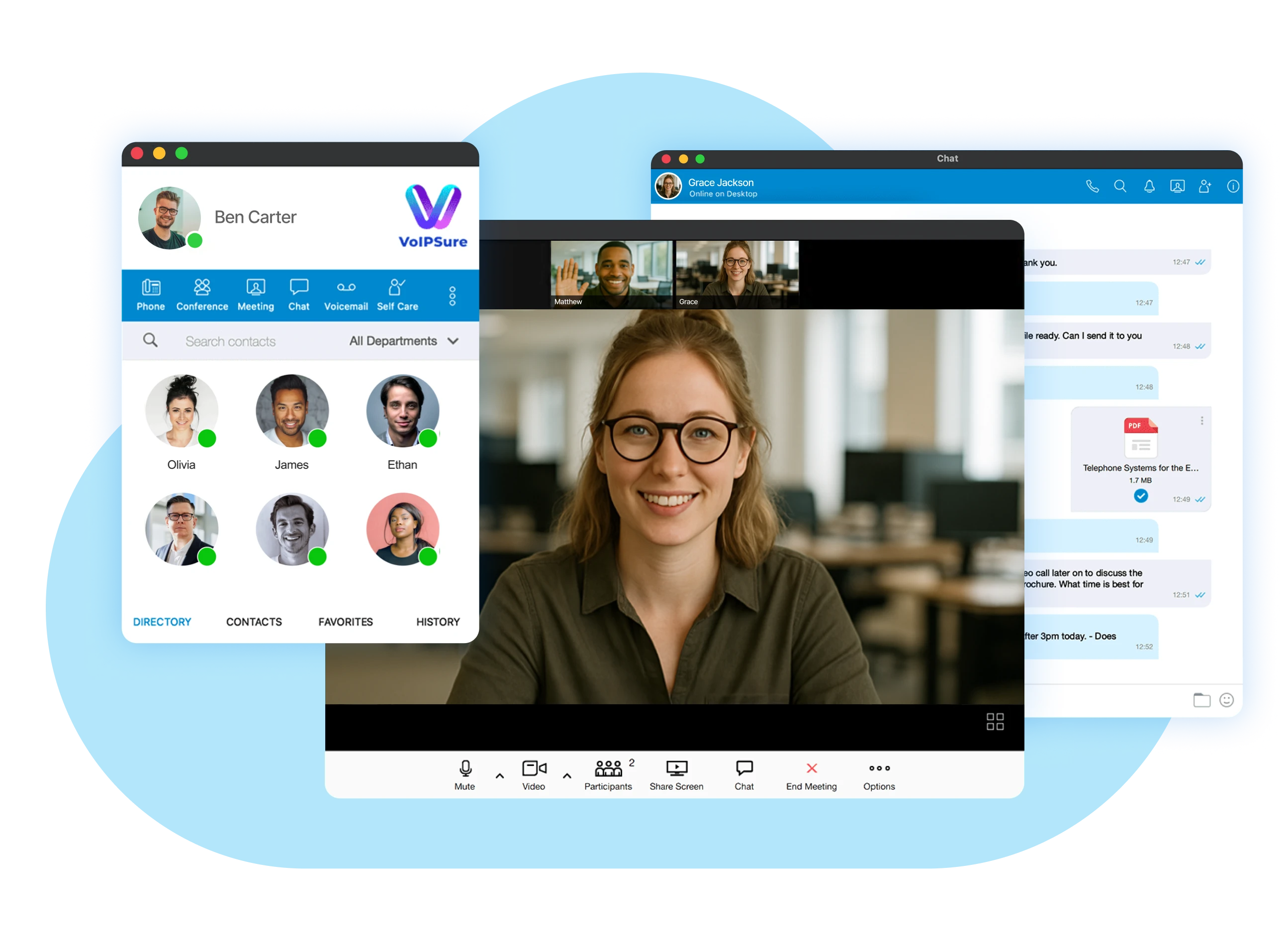
Not all VoIP systems are created equal. The right features can improve customer experience, support flexible working, and save your team time day to day. These are the core capabilities worth prioritising when comparing providers.
1. Call routing and forwarding
Hunt groups distribute calls across your team so customers reach someone quickly. Time-based routing sends after-hours calls to voicemail or a mobile.
2. Call recording with compliance features
Recording calls helps with training and dispute resolution. If you take card payments over the phone, look for PCI-compliant pause features that stop recording during sensitive information.
3. Mobile and desktop softphone apps
Apps let your team make business calls from personal devices while keeping their private number separate.
4. CRM and business software integration
Integration with existing tools saves time. Click-to-dial from your CRM and automatic call logging improve efficiency.
5. UK-based support availability
When phones stop working, speaking to someone who can help immediately matters. Providers with 24/7 UK-based support resolve issues faster than email-only contact or overseas call centres.
How do you switch to VoIP?

Moving to VoIP is usually simpler than businesses expect. With the right preparation and provider support, most companies can transition quickly without disrupting day-to-day operations. These steps outline what the process typically looks like.
1. Assess your current phone system
Review your existing setup. How many lines do you have? What features do you use? What works well, and what frustrates your team?
2. Check your broadband connection
VoIP requires adequate bandwidth. Each concurrent call uses around 100kbps upload and download. If your current broadband struggles, upgrading to FTTP or a leased line helps.
3. Choose a VoIP provider
Look for strong uptime guarantees, the features your business requires, responsive UK-based support, and flexible contract terms.
4. Port your existing numbers
You can keep your current business phone numbers. Number porting transfers them to your new VoIP system.
5. Install and configure your system
Quality providers handle setup quickly. Many cloud-based systems go live within 24 hours.
6. Train your team
A brief training session ensures everyone knows how to use the new features.
Best practices for maintaining VoIP call quality
Maintaining consistent VoIP call quality comes down to a few practical network and setup considerations. Get these right, and you avoid dropped calls, delays, and frustrating audio issues.
- Monitor network performance. Regular checks help identify issues before they impact users. Many VoIP platforms include built-in tools to monitor call quality and network health.
- Ensure adequate bandwidth. Each simultaneous call needs sufficient upload and download speed. Factor this in if your team runs multiple calls alongside video meetings or cloud tools.
- Configure Quality of Service (QoS) settings. QoS settings on your router prioritise voice traffic over other data, stopping large downloads or updates from disrupting calls.
- Use reliable VoIP hardware. Quality headsets and IP phones make a noticeable difference. Cheaper equipment often introduces echo, background noise, or connection problems.
How to get started with VoIP for your business
As you can now see, there are so many benefits of VoIP. VoIP delivers lower costs, greater flexibility, and advanced features. The drawbacks are manageable with reliable broadband and a reputable provider.
With the ISDN switch-off approaching, now is a practical time to explore options. B4BC’s VoIPSure platform combines the features covered here with 24/7 UK-based support and rapid installation, often within a day.
Get in touch with our telecoms experts for a conversation about the benefits of VoIP and what a VoIP system could look like for your business.
Benefits of VoIP FAQs
Cost savings combined with flexibility stand out. Businesses typically reduce phone bills while gaining the ability to work from anywhere.
Each concurrent call requires roughly 100kbps in both directions. For offices with multiple simultaneous calls, business-grade broadband like FTTP provides the stability VoIP requires.
Yes. Number porting is standard practice. Your existing business numbers transfer to the new system.
Cloud-based systems can forward calls to mobile phones during outages. However, having a mobile backup plan is wise if both internet and power go down.
Reputable providers offer GDPR-compliant systems with encryption and secure data handling. Check your provider’s security credentials before signing up.
Calls may experience delays or dropouts. Upgrading your broadband connection usually resolves the problem.
